A web edition is not a strategy
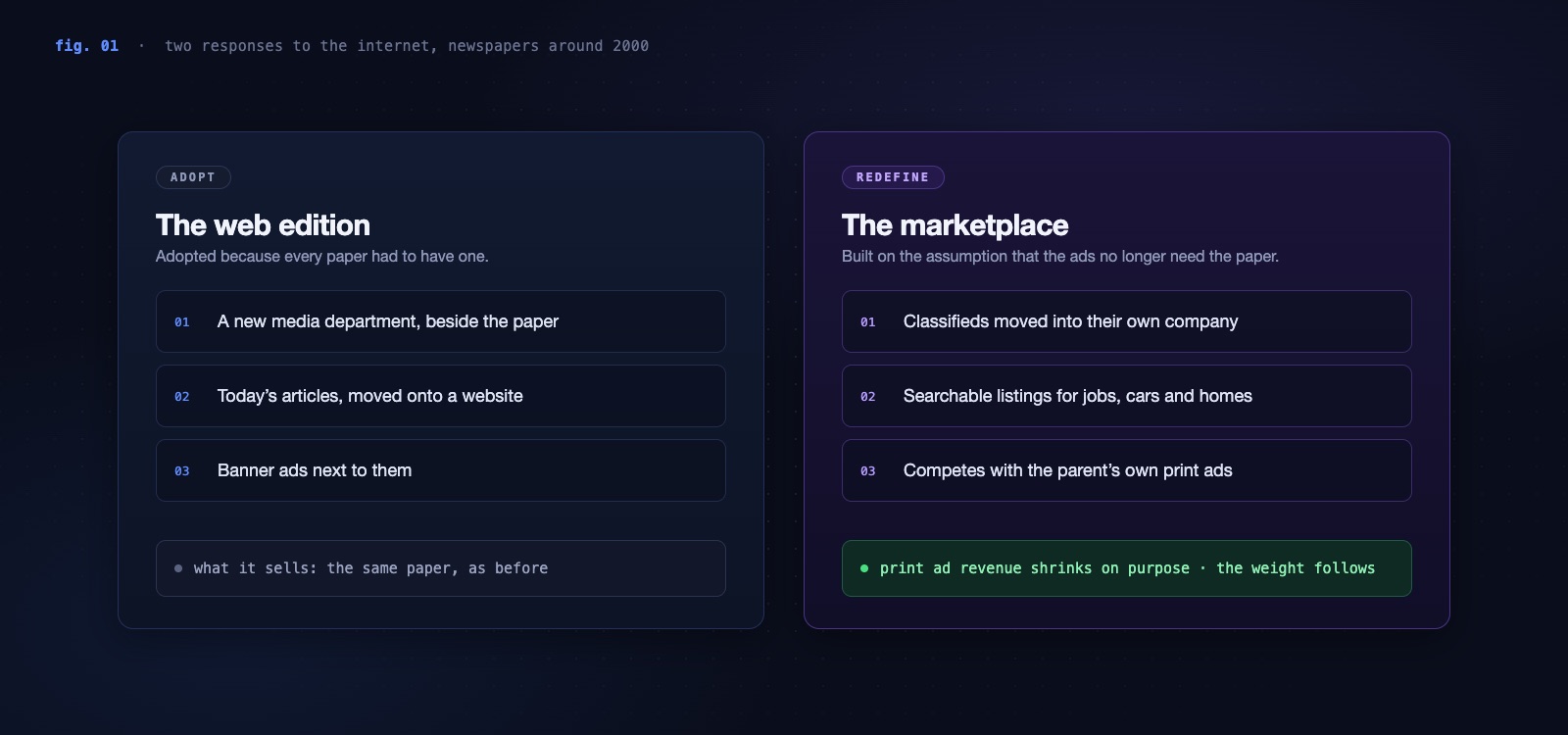
In the late nineties every newspaper had to have a website, and nearly every newspaper got one. The ones I find interesting are the few that asked what the internet did to the thing they were actually selling, because the answer had very little to do with news.
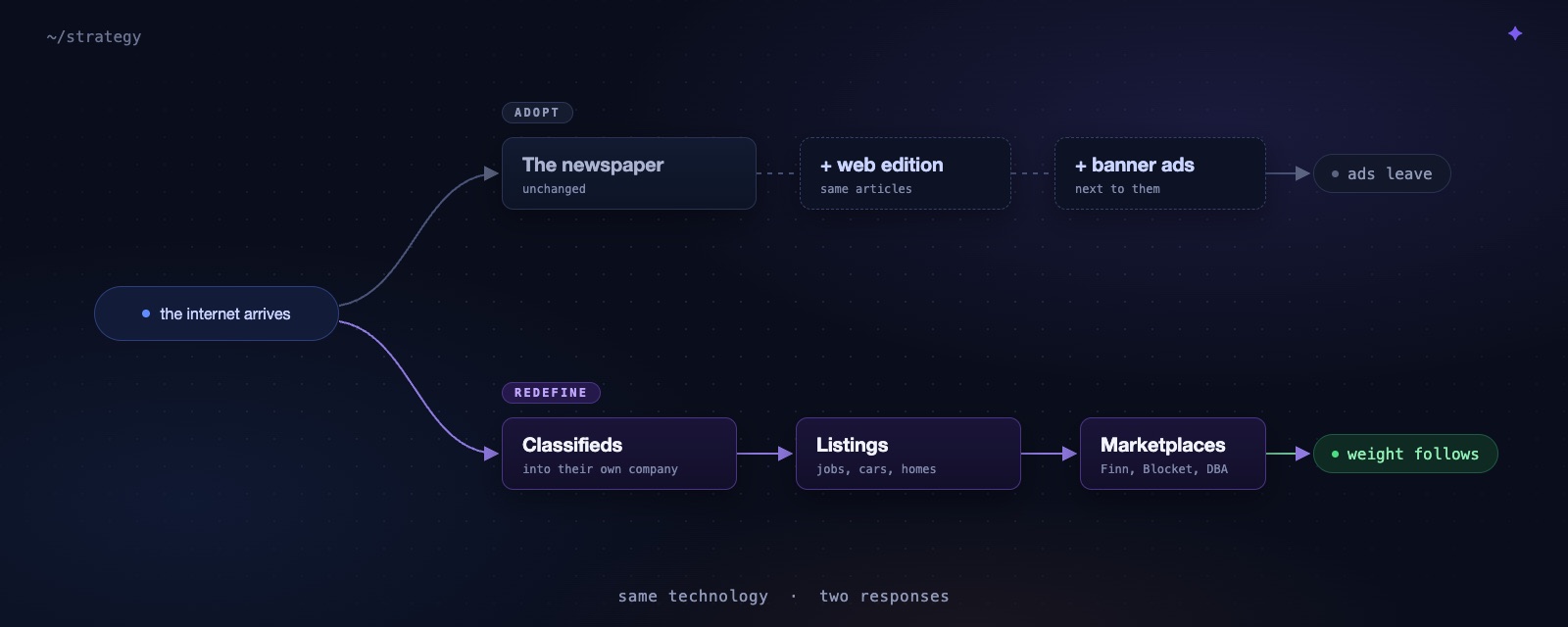
The common response was the web edition. Take today's paper, put the articles on a site, sell banner ads next to them, and set up a new media department to run it. The trade had a word for this, shovelware, because the content was shovelled from one medium into the other more or less unchanged. It was adopted because it had to be. The board was asking, the competitor across town had one, and "internet strategy" needed something underneath it on the slide. Nothing about what the company sold, or to whom, had moved.
What a newspaper sold, as far as the accounts were concerned, was largely small print. Jobs, cars and homes. In the United States classified ads brought in $19.6 billion in 2000, about 40 per cent of the industry's advertising revenue. By 2012 that figure was $4.6 billion. None of that was about the quality of the journalism. A searchable database is a better way to find a used Volvo than a page of abbreviations, and once one existed the ads moved to it and left the newspaper behind.
The one that moved
Schibsted is the case I keep coming back to. It's a Norwegian publisher founded in 1839, owner of Aftenposten and VG and, in Sweden, Aftonbladet and Svenska Dagbladet. In 2000 it took the classifieds out of its papers' hands and put them into a separate company, Finn.no, with a group of regional newspapers as co-owners. Schibsted held 62 per cent. Finn's job was to be the place Norwegians looked for a flat or a job, and doing it well meant taking those ads away from Aftenposten, the parent's own flagship.
Its 2001 annual report is worth reading for one reason: both responses are in it, in the same company and the same year. The online newspapers posted an operating loss of NOK 171 million, up from 87 million the year before. Aftenposten's advertising revenue fell 9 per cent. And Finn.no had, in the report's words, "strengthened its leading position in the Norwegian market".
Then it kept going. In December 2003 it bought Blocket, a Swedish marketplace for used cars and everything else, for SEK 183 million, through a company controlled by Aftonbladet. In December 2023 Schibsted announced it would sell its news media, Aftenposten and VG included, to the Tinius Trust. The final agreement in March 2024 put the price at NOK 6.3 billion, and the sale closed later that year. In May 2025 what was left took a new name. The company that listed on the Oslo exchange in 1992 as a newspaper publisher is now called Vend Marketplaces, and it doesn't own a newspaper. If you've sold a bicycle on DBA, you've been a customer.
The newspapers are fine, for what it's worth. Aftenposten and VG still come out, owned by the trust that was already Schibsted's largest shareholder, and I don't read the story as journalism losing. I also don't know how deliberate any of it was in 2000. From the outside, twenty-five years later, it looks like a plan. I'd guess that on the inside it was an argument the classifieds people happened to win.
Two flavours
When a technology shifts underneath a business, the strategy that comes out tends to be one of two kinds. Most of the time it's a scramble. Something has to exist, so a team is formed and the new technology gets attached to the side of the company, where it can complement what's there or defend it. That is quick and cheap, and it leaves every assumption about how the company makes money exactly where it was, which is most of its appeal.
Redefinition is the rare kind. It starts by accepting that the way customers get the job done has changed, and works backwards into what the company sells and what it stops doing. That puts somebody's existing revenue at risk, usually the revenue of the most senior person in the room. But if the shift really is fundamental, and you latch it onto the business on the assumption that it will complement it, you will most likely fall behind. You end up with a well-run web edition of a paper whose income has left by another door.
Owning a piece of it
Closer to home there's a case that looks like Schibsted's on paper and ended differently. I live in Denmark, where the digital letter won so completely that the paper one was shut down. e-Boks launched in 2001, built by the IT firm KMD together with Post Danmark, which later co-owned it with the payments company that became Nets. Since 1 November 2014 everyone aged 15 and over has had to receive mail from public authorities digitally. Letter volume has fallen by more than 90 per cent since 2000, and PostNord delivered its last letter on 30 December 2025. The service had been running since 1624.
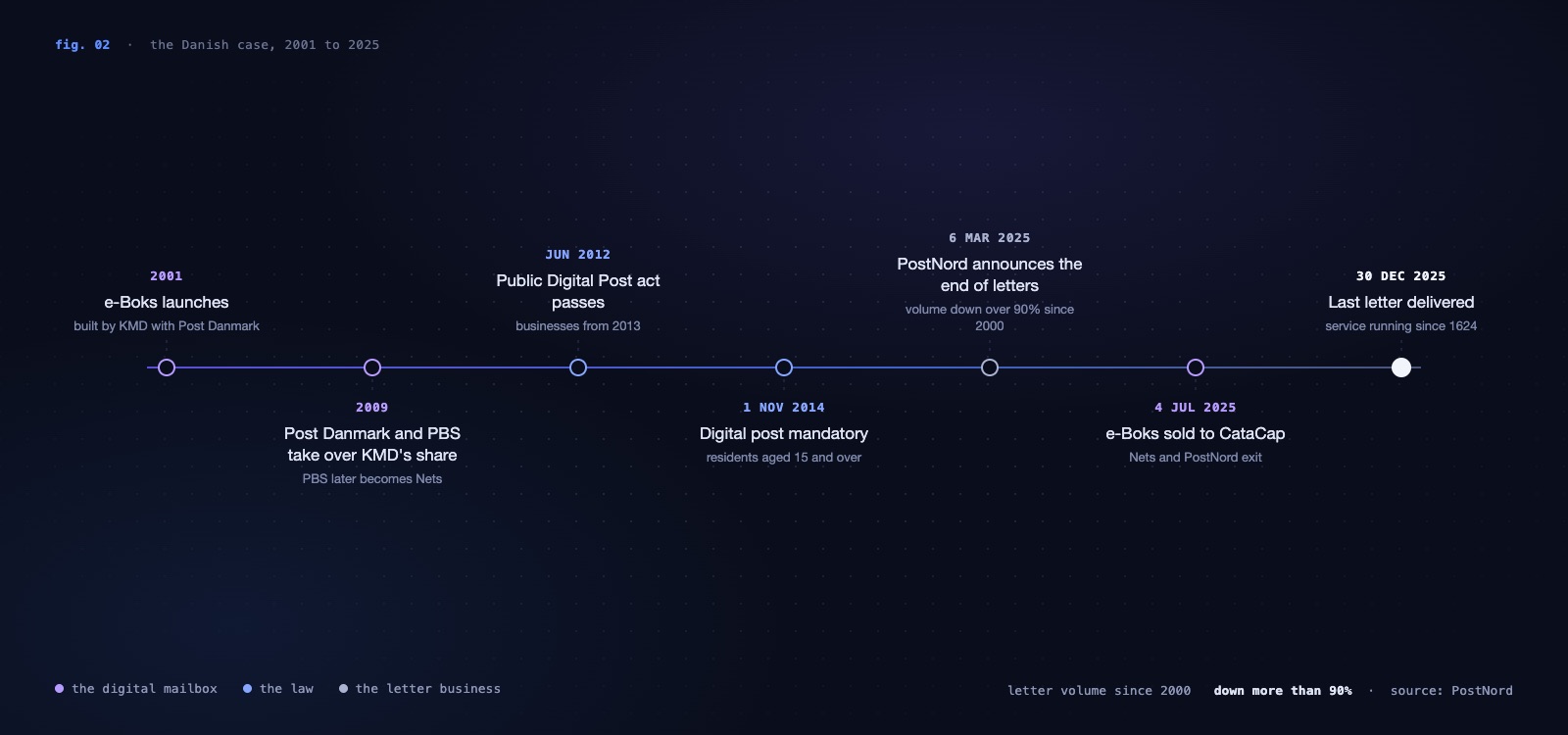
So Post Danmark was in on the replacement for its own product from the first day, which is more than most newspapers could say. The setup even resembles Finn: a separate company, co-owned, doing digitally what the parent did physically. Where they part is in where the weight went. Schibsted moved its money and eventually its name over to the marketplaces. e-Boks stayed a shareholding next to a post office that remained organised around vans and sorting centres. In 2025, the same year it gave up letters, PostNord sold its share to the private equity fund CataCap. That deal closed on 4 July.
I won't pretend the alternative was easy for a state-owned operator with a duty to reach every address in the country. But "they missed it" is the wrong reading. They were in on the new thing from 2001, and the old business was never rebuilt around it.
PostNord is still here, to be fair. It delivers parcels, and parcels are a business the internet handed to postal services at about the same time as it took the letters away. If you need to send a paper letter in Denmark now, it goes with Dansk Avis Omdeling, whose name translates roughly as Danish newspaper delivery.
Most shifts are small ones
Most new technologies are complements, and treating them that way is correct. No newspaper needed to rebuild itself around desktop publishing, and no postal service around barcode scanners.
Telling which kind you're looking at while it's still early is the hard part. The question I find most useful is whether the technology changes how you deliver the thing the customer pays for, or whether they still need that thing from you at all. A barcode scanner changes delivery. A searchable database of used cars removes the advertiser's need for a newspaper.
A smaller tell, and this one is a prejudice of mine: I distrust any strategy with the technology's name in it. Internet strategy, mobile strategy, cloud strategy, AI strategy. The name gives away that the technology is being handled as a topic next to the business, with its own owner and its own budget. I doubt anyone at Finn thought of their work as an internet strategy. It was the classifieds business, run by people who took the internet as given.
The AI department
With language models the same two flavours are on offer again, and the first one is winning by a wide margin.
You can list the scramble version from memory: an AI team, an "AI strategy" in the annual report, a chatbot on the support page and a summarise button in the product. I've shipped that chatbot myself, so I say this with some sympathy. It was worth building and it answered a lot of questions. In the terms of this article it is also a web edition, since the product behind it was the same product the day after launch.
Redefining starts from the customer's job again. In bookkeeping software, which is the corner I know best, the product has for a long time been a good screen for entering vouchers. If a model can read the receipt and book it, then the entry screen is the page of small print, and a summarise button on top of it changes nothing about that. What the company sells and who it hires both have to move.
Heivol has it easy here. It's small and new and there's no print edition to protect, so the products could be built from the start on the assumption that an agent does part of the work and a person checks it. The earlier article on working with LLMs is about that.
Which one are you in
A few things I'd look at, of very unequal weight.
Where the weight goes. The obvious tell would be the org chart: if the new technology has its own unit and its own budget, it has been latched on. Finn and e-Boks both spoil that, since both were separate companies and only one of them became the business. What separates them is where the money and the best people went over the following ten years. A separate unit that the parent is free to ignore is the web edition again.
Whose revenue it threatens. Finn took its ads from Aftenposten. If nothing in your plan costs an existing revenue line anything, the plan is a complement, whatever the slide says. This is the one I'd weigh most. It's also the one that gets negotiated away first, because the person who owns that revenue is in the meeting.
What you've stopped doing. A redefinition has a list of things that ended. Schibsted's list eventually had newspapers on it, which I would not have predicted and I doubt they did.
Back to the web edition for a moment, because I've been a little unfair to it. Newspapers needed websites, and the people in those new media departments mostly built what they were asked for. Several of those sites are now the newspaper. The problem was the question they were handed, how to put the paper online, and that was set well above them by people who wanted the internet to be an addition. I don't think that part has changed much.
I don't know which of today's AI-native claims, ours included, will look like a web edition in ten years. Some will. The revenue question is the best check I have, and it isn't a great one for a company as young as Heivol, where there's little old revenue to threaten.
Sources
- Schibsted ASA, Annual Report 2001: Finn.no ownership (62 per cent), the online newspapers' operating loss, Aftenposten's advertising revenue, Finn's position in Norway.
- Schibsted press release, 5 December 2003: Finnmer acquires Blocket AB: the price and the Aftonbladet ownership.
- Schibsted, 22 March 2024: final agreement on the sale of news media to the Tinius Trust: the NOK 6.3 billion value and the brands included.
- Vend, 12 May 2025: Schibsted Marketplaces becomes Vend: the new name and the marketplaces it owns, DBA among them.
- MinnPost, February 2014: How Craigslist killed the newspapers' golden goose: US classified revenue in 2000 and 2012, from Newspaper Association of America data.
- PostNord Group, 2025: PostNord to discontinue handling mail in Denmark: the fall in letter volume since 2000 and the last delivery date.
- e-Boks, July 2025: CataCap takes ownership of e-Boks: the sale by Nets and PostNord.
- Wikipedia: Vend Marketplaces ASA, Tinius Trust, E-Boks and Post Danmark: founding and listing years, the trust's shareholding, the e-Boks and Digital Post dates, and 1624.
If you read either case differently, particularly if you were there, write to [email protected]. This is also the kind of question we work on in consulting engagements.